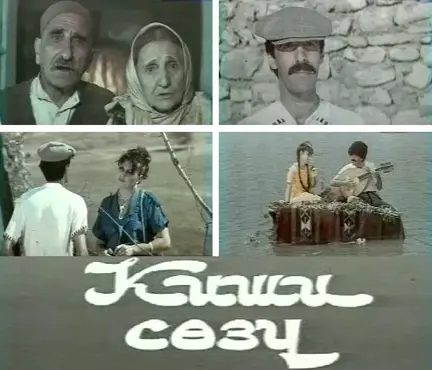
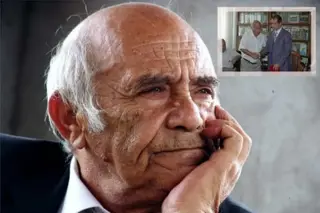
Mukhtar Hasan oghlu Avsharov was born on 15 February 1914 in the city of Yerevan. In 1918, as a result of the Armenian genocide policy, the family relocated to Turkey along with other family members. However, since they could not stay there for long, the family first moved to Baku and then to Ganja. In 1922 he studied at the railway school in Ganja, and after finishing the ninth grade he came to Baku on his grandfather's initiative and began studying at a vocational school. Since his passion for the arts and theatre never left him alone even in his school years, in his free time he took to the stage as an actor in the drama circle of Agasalim Manafli at the Railway Workers' House of Culture. Before long, the prominent actor Ulvi Rajab began to lead that circle and staged Alexander Shirvanzadeh's play "Namus" ("Honour") as its first production. It was from this great artist that M. Avsharov received his first theatre training. He was entrusted with the role of Sumbat in the play. Having finished the vocational school in 1933 and returned to Ganja, M. Avsharov worked as an assistant engine-driver at the Ganja locomotive depot while continuing his work as an actor at the Railway Workers' Young Spectators' Theatre. He played leading roles in several productions staged by directors such as Habib Ismayilov and Rza Sarabski. In 1936 he was sent by the newly formed political department to Moscow for a two-month cultural-educational course, and after completing it he was appointed to a mass-work position at the Ganja House of Culture. Some time later he was invited to the Ganja State Drama Theatre. Making his professional stage debut in the role of Haji Kazim in Jalil Mammadguluzadeh's "Ölülər", M. Avsharov later appeared as Zulfugar in Samad Vurgun's play "Vaqif" and in Jafar Jabbarli's works "Nəsrəddin şah", "Yaşar", "1905-ci ildə" and "Almaz". Three days after the Great Patriotic War began, he was arrested for his political views. It was alleged that M. Avsharov had objected in public to the renaming of Ganja as "Kirovabad" and to naming the Ganja Theatre after Beria. Having spent five years in detention, M. Avsharov was finally released five years ahead of his term as a result of the petitions he wrote. Upon his return, the Ganja Theatre staged Suleyman Sani Akhundov's "Eşq və intiqam" and entrusted him with the leading role. The day after the premiere, he was dismissed from the theatre once again. The order was that he must not appear in public, among the public. Left unemployed for a while, M. Avsharov worked as a labourer at a mill, and finally, after Stalin's death, resumed his work at the Ganja Theatre. For his successful performances at the Jafar Jabbarli Ganja State Drama Theatre, M. Avsharov was awarded the honorary title of Honoured Artist of the Republic in 1960. Invited to the Azerbaijan State Academic Drama Theatre in 1968, the artist worked there until the end of the 1990s, creating characters of various natures in hundreds of productions. Whenever the subject of friendship came up, M. Avsharov would jokingly say: "I have always had a very sincere attitude towards women. I value my friendship with them highly, because you can trust them with secrets." During this period, filming began at the "Azərbaycanfilm" studio on Huseyn Seyidzade's film "Dəli Kür," in which Mukhtar Avsharov was given a rather small role. The success of this role increased his involvement in cinema, and afterwards filming began on "Atları yəhərləyin." Here, playing the Iranian village headman, Mukhtar Avsharov displayed a characterful piece of acting. In 1989, in line with the decisions of the perestroika period, M. Avsharov was dismissed from work under the decision that people over 60 years of age had to retire. In 1992 the People's Artist Amaliya Panahova founded her own Baku Municipal Theatre and invited the veteran actor Mukhtar Avsharov to join it. During his time at the theatre he created a gallery of interesting and varied characters in productions such as "Nadir şah" (Nariman Narimanov) and "Dönüş" (Jafar Jabbarli), among many others. In 1996 the "Sönməyən ulduzlar" theatre began operating under the Culture Fund, and Mammadkamal Kazimov, who worked as a director there, invited M. Avsharov to join. He was entrusted with the role of Uncle Abdul in Jafar Jabbarli's play "Solğun çiçəklər." Towards the end of his life his eyesight began to weaken. Even in such difficult times, he was still invited to take on new roles. The prominent film director Vagif Mustafayev invited him to the film set, and the actor was filmed while merely counting his footsteps. On 2 October 2002 Mukhtar Avsharov was awarded a personal pension from the President of the Republic of Azerbaijan, and on 7 November of that same year, in connection with the tenth anniversary of the Baku Municipal Theatre, he was awarded the honorary title of People's Artist. In 2004, by order of the President of the Republic of Azerbaijan, he was awarded the "Shohrat" ("Glory") Order. Mukhtar Hasan oghlu Avsharov passed away in December 2004.