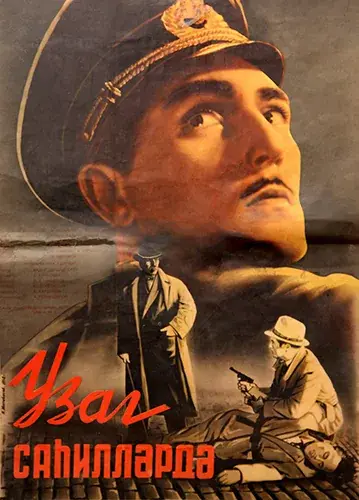
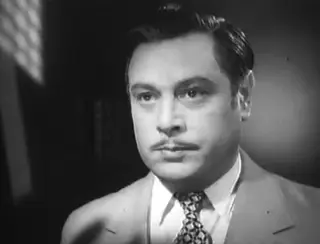
Lev Bordukov was born in 1913 in Moscow. He began his artistic career at the age of 16. From 1929 to 1932 he was an actor at the Moscow Workers' Theatre. He made his screen debut in 1933 in the film The Sun Rises in the West, about the hardship of German workers and the communists' struggle against capitalists. In 1933 he was accepted as an actor at the Moscow Art Theatre, where he worked until he was called up for the Second World War in 1941. He fought in the Great Patriotic War until 1943, when he was seriously wounded by a sudden gunshot and discharged as unfit for further service. After returning from the war he began performing on the stage of the Central Transport Theatre and its theatre studio. Lev's fiery character and strong sense of justice drew him into the internal conflicts that arose in the country after the war. Within a short time he was arrested for anti-Soviet propaganda and exiled to the Norilsk corrective labour camp in Siberia. Norilsk was known as the "city on bones" — more than 7,500 people died there during the Second World War; they were first buried in mass graves and later cremated in specially built furnaces. Lev Bordukov served in this camp from 1947 to 1952. Even there he did not abandon acting, performing in the ensemble of the Ministry of Internal Affairs' corrective-labour unit and in the Norilsk Theatre, made up of prisoners. But these five years cost him dearly, leaving him with serious health problems. After his release he spent three years as an actor at the Chelyabinsk Drama Theatre and the Tambov Drama Theatre. He then worked at the Lunacharsky Theatre, the Kyiv Russian Drama Theatre and finally the Vladimir Mayakovsky Theatre, which became his last stop — he worked there from 1955 to 1967. He also appeared in films. In 1956 Lev Bordukov played a French partisan in the film Lost, about the struggle of unknown heroes of the Great Patriotic War and internationalists against fascism. With this film Lev became one of the leading names of Soviet film distribution — more than 35 million viewers watched it and fell for the actor. After this film Tofig Taghizade invited the actor to play Carranti in On Distant Shores. At the same time the actor also appeared in the film Kyiv. Filming for On Distant Shores took place in Baku, Sochi and the Baltic countries, with the final scenes shot in villages of the Aghsu district. Unfortunately, during filming the actor drank frequently, seemingly trying to drown the pain of what he had seen and lived through during his imprisonment. Once he even failed to show up for filming, citing illness. In those years filming followed a strict plan, and directors had to report to higher authorities every day, even for every metre of film shot. A very important scene had to be filmed in which Carranti confronts Mikhaylo over his betrayal. Faced with this extreme situation, Tofig Taghizade urgently had the second director Rufat Shabanov made up and filmed from behind and in profile. Once Lev arrived for filming, close-up shots with him were recorded. His addiction to alcohol brought the actor close to arrest several times. This happened again during the filming of On Distant Shores. During filming, actors were not given daily allowance money. Bordukov decided to play a "joke": he deceived a post office worker into sending director Teymur Huseynov a telegram reading: "If you don't pay the actors, the 'Black Cat' gang will get involved." In the post-war years the "Black Cat" gang had become a legend among the people for its daring raids. In 1953 many of its members were arrested, and some disappeared, though later imitators using the same name emerged. After this telegram, Teymur Huseynov went to the police, and the post office worker was detained; no matter how much he swore that a certain actor had asked him to do it, he was not believed. Bordukov's next escapade involved the KGB office in Sochi. While walking around the city, he approached the entrance of the building, pulled out of his pocket a photograph of Wilhelm Canaris — head of the counter-intelligence service, which he had used in the film — showed it and said: "Tonight a Turkish ship will come ashore and take us away from here!" When he was detained and questioned, he said: "I am an American intelligence officer." Naturally he was arrested and Moscow was immediately notified that an American agent had been caught. The order came: "Deliver him to Moscow by plane in the morning." The next day, once he had sobered up, Bordukov began to swear that he was simply an actor playing a role in a film. Although a call to the hotel where the film crew was staying confirmed this was true, the rule-breaker was not released. In the end the authorities decided to punish Bordukov for petty hooliganism and gave him 15 days' detention. By the rules he should have had his head shaved and been sent to a labour camp, but the film's director explained that cutting the actor's hair would create a serious obstacle for filming. As a result, Bordukov was brought to the film set every day by investigators and returned afterwards once filming was over. Following this incident Bordukov was banned from film work for three years, after which his film career declined. Playing three minor roles and continuing to perform on stage, Bordukov was invited in 1966 by Alisattar Atakishiyev to appear in the film The Investigation Continues, about Soviet counter-intelligence officers battling spies hunting for Soviet secrets. Bordukov played KGB major Martynov, reincarnated as the American spy Houk. Bordukov's final role came in 1967 in Rauf Kazimovsky's film The Postbox, in which he played the presiding judge. That same year, on 18 May, at the age of 54, Lev Bordukov died.